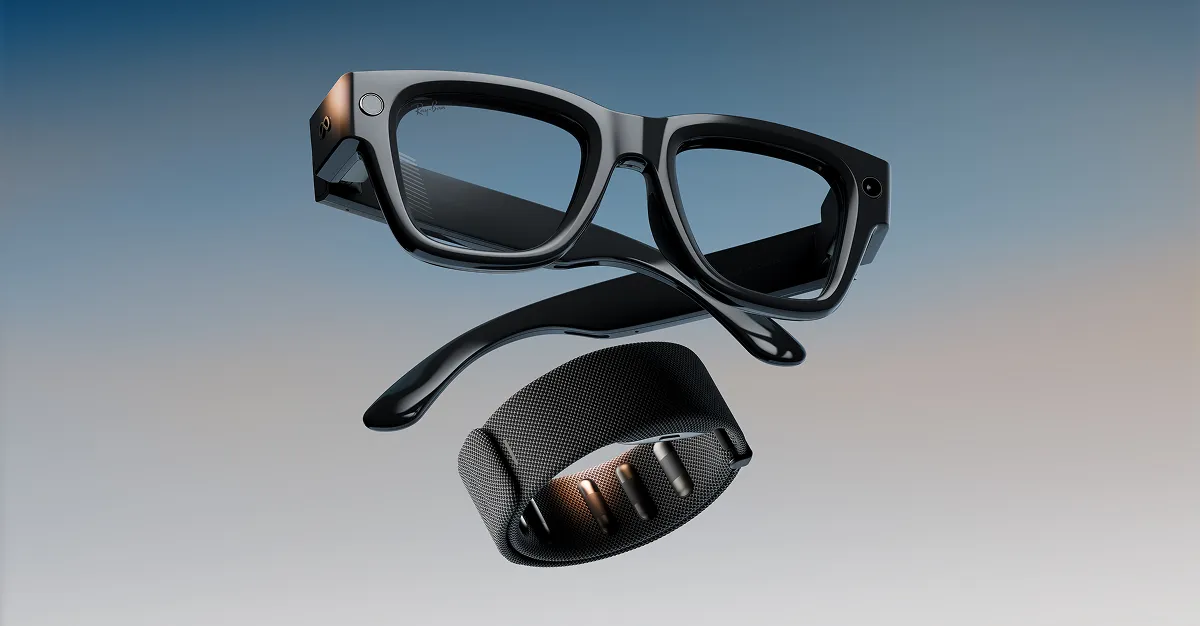
What Meta Ray-Ban Display May Tell Us About the Future of VR and AR
Recently, Meta revealed new information about the “Meta Ray-Ban Display.”
For years, Meta has continued investing heavily in VR and the metaverse, but recently their focus seems to be shifting toward AR glasses, neural input systems, and what could become the next major interface after smartphones.
A few years ago, the metaverse became a huge trend.
Today, that excitement has clearly calmed down.
Because of this, many people may feel that VR and the metaverse ultimately failed to become mainstream.
However, I have recently started seeing things a little differently.
The Key May Not Be the Metaverse — But the Device
What stood out to me about the Meta Ray-Ban Display was that it did not feel like “the next VR headset.”
Instead, it felt closer to:
“the next smartphone interface.”
Traditional VR focused on complete immersion through large headsets.
That approach creates powerful experiences.
Live events, games, films, virtual worlds.
By separating users from the physical world, VR can create deep immersion and presence.
But at the same time, VR headsets are still heavy, tiring, and difficult to wear continuously.
That is one reason why mass adoption has remained difficult.
AR Glasses Feel More Like “Always Connected”
AR glasses seem to be moving in a different direction.
They may not provide the same level of immersion as VR headsets.
But instead, they offer something else:
a feeling of constant connection.
This feels less like VR, and more like:
“the successor to the smartphone.”
Instead of repeatedly pulling a phone out of your pocket, information becomes layered directly onto physical space itself.
That changes the feeling of the internet completely.
From “Looking at Screens” to “Connecting to Space”
Today’s internet is still mostly screen-based.
We look at screens to access information, communication, music, maps, and social media.
But AR and spatial interfaces may gradually change that relationship.
Location data, AI assistants, translation, music, notifications, communication —
instead of existing inside a screen, they may begin existing inside space itself.
I think this could become a very significant shift.
VR and AR May Evolve Into Different Roles
Recently, I have started feeling that VR and AR may not evolve toward the same destination.
Instead, they may separate into completely different layers.
AR may become:
daily life, lightweight connection, spatial communication, always-on interaction.
VR may become:
deep immersion, live experiences, events, virtual gatherings, shared worlds.
In other words:
AR may connect people casually throughout the day,
while VR becomes the place people intentionally “enter.”
That relationship feels somewhat similar to the relationship between social media and live events today.
Why I See Musical Potential in This
I mainly create music in the fields of Minimal Techno, Ambient, and IDM.
These genres are not only about melodies or lyrics.
They also explore atmosphere, repetition, texture, immersion, and space itself.
That is why I feel spatial interfaces such as VR and AR have a strong connection with music.
Music may gradually shift from being something we simply “play,”
into something that exists inside space around us.
What I Am Exploring Through ZONE
Currently, I am still in the experimental stage.
I have been creating VR worlds where sound reacts to visuals and space, while exploring how music can become part of immersive environments.
ZONE is part of that exploration.
I feel that in the future, what matters may not only be:
“what information we have,”
but also:
“what kinds of spaces we can share.”
That is why I want to continue exploring the possibilities of spatial culture through music, VR, and AR.
関連記事一覧

VRChatってどう楽しむの?初心者向けガイド!How to Enjoy VRCh...

Why I Started Exploring VR as a Music Space
What the Metaverse Still Lacks: Beyond Games, Toward Intell...

Why I Chose VR as a Space for the Next Civilization
VRゴーグルなしでVRChatを始める方法 -How to Start VRChat Wit...
